




RNSA 2023 Abdominal Trauma Detection
Install Libraries
#Install Libraries
!python -m pip install --no-index --find-links=/kaggle/input/libraries seaborn
!python -m pip install --no-index --find-links=/kaggle/input/libraries keras-cv-attention-models
!python -m pip install --no-index --find-links=/kaggle/input/libraries scikit-learn
#!python -m pip install --no-index --find-links=/kaggle/input/libraries-add02 python-gdcm
!python -m pip install --no-index --find-links=/kaggle/input/libraries-add02 pylibjpeg
!python -m pip install --no-index --find-links=/kaggle/input/libraries-add02 pydicom
Looking in links: /kaggle/input/libraries
Requirement already satisfied: seaborn in /opt/conda/lib/python3.10/site-packages (0.12.2)
Requirement already satisfied: numpy!=1.24.0,>=1.17 in /opt/conda/lib/python3.10/site-packages (from seaborn) (1.23.5)
Requirement already satisfied: pandas>=0.25 in /opt/conda/lib/python3.10/site-packages (from seaborn) (2.0.2)
Requirement already satisfied: matplotlib!=3.6.1,>=3.1 in /opt/conda/lib/python3.10/site-packages (from seaborn) (3.7.2)
Requirement already satisfied: contourpy>=1.0.1 in /opt/conda/lib/python3.10/site-packages (from matplotlib!=3.6.1,>=3.1->seaborn) (1.1.0)
Requirement already satisfied: cycler>=0.10 in /opt/conda/lib/python3.10/site-packages (from matplotlib!=3.6.1,>=3.1->seaborn) (0.11.0)
Requirement already satisfied: fonttools>=4.22.0 in /opt/conda/lib/python3.10/site-packages (from matplotlib!=3.6.1,>=3.1->seaborn) (4.40.0)
Requirement already satisfied: kiwisolver>=1.0.1 in /opt/conda/lib/python3.10/site-packages (from matplotlib!=3.6.1,>=3.1->seaborn) (1.4.4)
Requirement already satisfied: packaging>=20.0 in /opt/conda/lib/python3.10/site-packages (from matplotlib!=3.6.1,>=3.1->seaborn) (21.3)
Requirement already satisfied: pillow>=6.2.0 in /opt/conda/lib/python3.10/site-packages (from matplotlib!=3.6.1,>=3.1->seaborn) (9.5.0)
Requirement already satisfied: pyparsing<3.1,>=2.3.1 in /opt/conda/lib/python3.10/site-packages (from matplotlib!=3.6.1,>=3.1->seaborn) (3.0.9)
Requirement already satisfied: python-dateutil>=2.7 in /opt/conda/lib/python3.10/site-packages (from matplotlib!=3.6.1,>=3.1->seaborn) (2.8.2)
Requirement already satisfied: pytz>=2020.1 in /opt/conda/lib/python3.10/site-packages (from pandas>=0.25->seaborn) (2023.3)
Requirement already satisfied: tzdata>=2022.1 in /opt/conda/lib/python3.10/site-packages (from pandas>=0.25->seaborn) (2023.3)
Requirement already satisfied: six>=1.5 in /opt/conda/lib/python3.10/site-packages (from python-dateutil>=2.7->matplotlib!=3.6.1,>=3.1->seaborn) (1.16.0)
Looking in links: /kaggle/input/libraries
Processing /kaggle/input/libraries/keras_cv_attention_models-1.3.20-py3-none-any.whl
Requirement already satisfied: pillow in /opt/conda/lib/python3.10/site-packages (from keras-cv-attention-models) (9.5.0)
Processing /kaggle/input/libraries/ftfy-6.1.1-py3-none-any.whl (from keras-cv-attention-models)
Requirement already satisfied: regex in /opt/conda/lib/python3.10/site-packages (from keras-cv-attention-models) (2023.6.3)
Requirement already satisfied: tensorflow-datasets in /opt/conda/lib/python3.10/site-packages (from keras-cv-attention-models) (4.9.2)
Requirement already satisfied: tensorflow in /opt/conda/lib/python3.10/site-packages (from keras-cv-attention-models) (2.12.0)
Requirement already satisfied: wcwidth>=0.2.5 in /opt/conda/lib/python3.10/site-packages (from ftfy->keras-cv-attention-models) (0.2.6)
Requirement already satisfied: absl-py>=1.0.0 in /opt/conda/lib/python3.10/site-packages (from tensorflow->keras-cv-attention-models) (1.4.0)
Requirement already satisfied: astunparse>=1.6.0 in /opt/conda/lib/python3.10/site-packages (from tensorflow->keras-cv-attention-models) (1.6.3)
Requirement already satisfied: flatbuffers>=2.0 in /opt/conda/lib/python3.10/site-packages (from tensorflow->keras-cv-attention-models) (23.5.26)
Requirement already satisfied: gast<=0.4.0,>=0.2.1 in /opt/conda/lib/python3.10/site-packages (from tensorflow->keras-cv-attention-models) (0.4.0)
Requirement already satisfied: google-pasta>=0.1.1 in /opt/conda/lib/python3.10/site-packages (from tensorflow->keras-cv-attention-models) (0.2.0)
Requirement already satisfied: grpcio<2.0,>=1.24.3 in /opt/conda/lib/python3.10/site-packages (from tensorflow->keras-cv-attention-models) (1.51.1)
Requirement already satisfied: h5py>=2.9.0 in /opt/conda/lib/python3.10/site-packages (from tensorflow->keras-cv-attention-models) (3.9.0)
Requirement already satisfied: jax>=0.3.15 in /opt/conda/lib/python3.10/site-packages (from tensorflow->keras-cv-attention-models) (0.4.13)
Requirement already satisfied: keras<2.13,>=2.12.0 in /opt/conda/lib/python3.10/site-packages (from tensorflow->keras-cv-attention-models) (2.12.0)
Requirement already satisfied: libclang>=13.0.0 in /opt/conda/lib/python3.10/site-packages (from tensorflow->keras-cv-attention-models) (16.0.0)
Requirement already satisfied: numpy<1.24,>=1.22 in /opt/conda/lib/python3.10/site-packages (from tensorflow->keras-cv-attention-models) (1.23.5)
Requirement already satisfied: opt-einsum>=2.3.2 in /opt/conda/lib/python3.10/site-packages (from tensorflow->keras-cv-attention-models) (3.3.0)
Requirement already satisfied: packaging in /opt/conda/lib/python3.10/site-packages (from tensorflow->keras-cv-attention-models) (21.3)
Requirement already satisfied: protobuf!=4.21.0,!=4.21.1,!=4.21.2,!=4.21.3,!=4.21.4,!=4.21.5,<5.0.0dev,>=3.20.3 in /opt/conda/lib/python3.10/site-packages (from tensorflow->keras-cv-attention-models) (3.20.3)
Requirement already satisfied: setuptools in /opt/conda/lib/python3.10/site-packages (from tensorflow->keras-cv-attention-models) (68.0.0)
Requirement already satisfied: six>=1.12.0 in /opt/conda/lib/python3.10/site-packages (from tensorflow->keras-cv-attention-models) (1.16.0)
Requirement already satisfied: tensorboard<2.13,>=2.12 in /opt/conda/lib/python3.10/site-packages (from tensorflow->keras-cv-attention-models) (2.12.3)
Requirement already satisfied: tensorflow-estimator<2.13,>=2.12.0 in /opt/conda/lib/python3.10/site-packages (from tensorflow->keras-cv-attention-models) (2.12.0)
Requirement already satisfied: termcolor>=1.1.0 in /opt/conda/lib/python3.10/site-packages (from tensorflow->keras-cv-attention-models) (2.3.0)
Requirement already satisfied: typing-extensions>=3.6.6 in /opt/conda/lib/python3.10/site-packages (from tensorflow->keras-cv-attention-models) (4.6.3)
Requirement already satisfied: wrapt<1.15,>=1.11.0 in /opt/conda/lib/python3.10/site-packages (from tensorflow->keras-cv-attention-models) (1.14.1)
Requirement already satisfied: tensorflow-io-gcs-filesystem>=0.23.1 in /opt/conda/lib/python3.10/site-packages (from tensorflow->keras-cv-attention-models) (0.32.0)
Requirement already satisfied: array-record in /opt/conda/lib/python3.10/site-packages (from tensorflow-datasets->keras-cv-attention-models) (0.4.0)
Requirement already satisfied: click in /opt/conda/lib/python3.10/site-packages (from tensorflow-datasets->keras-cv-attention-models) (8.1.7)
Requirement already satisfied: dm-tree in /opt/conda/lib/python3.10/site-packages (from tensorflow-datasets->keras-cv-attention-models) (0.1.8)
Requirement already satisfied: etils[enp,epath]>=0.9.0 in /opt/conda/lib/python3.10/site-packages (from tensorflow-datasets->keras-cv-attention-models) (1.3.0)
Requirement already satisfied: promise in /opt/conda/lib/python3.10/site-packages (from tensorflow-datasets->keras-cv-attention-models) (2.3)
Requirement already satisfied: psutil in /opt/conda/lib/python3.10/site-packages (from tensorflow-datasets->keras-cv-attention-models) (5.9.3)
Requirement already satisfied: requests>=2.19.0 in /opt/conda/lib/python3.10/site-packages (from tensorflow-datasets->keras-cv-attention-models) (2.31.0)
Requirement already satisfied: tensorflow-metadata in /opt/conda/lib/python3.10/site-packages (from tensorflow-datasets->keras-cv-attention-models) (0.14.0)
Requirement already satisfied: toml in /opt/conda/lib/python3.10/site-packages (from tensorflow-datasets->keras-cv-attention-models) (0.10.2)
Requirement already satisfied: tqdm in /opt/conda/lib/python3.10/site-packages (from tensorflow-datasets->keras-cv-attention-models) (4.66.1)
Requirement already satisfied: wheel<1.0,>=0.23.0 in /opt/conda/lib/python3.10/site-packages (from astunparse>=1.6.0->tensorflow->keras-cv-attention-models) (0.40.0)
Requirement already satisfied: importlib_resources in /opt/conda/lib/python3.10/site-packages (from etils[enp,epath]>=0.9.0->tensorflow-datasets->keras-cv-attention-models) (5.12.0)
Requirement already satisfied: zipp in /opt/conda/lib/python3.10/site-packages (from etils[enp,epath]>=0.9.0->tensorflow-datasets->keras-cv-attention-models) (3.15.0)
Requirement already satisfied: ml-dtypes>=0.1.0 in /opt/conda/lib/python3.10/site-packages (from jax>=0.3.15->tensorflow->keras-cv-attention-models) (0.2.0)
Requirement already satisfied: scipy>=1.7 in /opt/conda/lib/python3.10/site-packages (from jax>=0.3.15->tensorflow->keras-cv-attention-models) (1.11.2)
Requirement already satisfied: charset-normalizer<4,>=2 in /opt/conda/lib/python3.10/site-packages (from requests>=2.19.0->tensorflow-datasets->keras-cv-attention-models) (3.1.0)
Requirement already satisfied: idna<4,>=2.5 in /opt/conda/lib/python3.10/site-packages (from requests>=2.19.0->tensorflow-datasets->keras-cv-attention-models) (3.4)
Requirement already satisfied: urllib3<3,>=1.21.1 in /opt/conda/lib/python3.10/site-packages (from requests>=2.19.0->tensorflow-datasets->keras-cv-attention-models) (1.26.15)
Requirement already satisfied: certifi>=2017.4.17 in /opt/conda/lib/python3.10/site-packages (from requests>=2.19.0->tensorflow-datasets->keras-cv-attention-models) (2023.7.22)
Requirement already satisfied: google-auth<3,>=1.6.3 in /opt/conda/lib/python3.10/site-packages (from tensorboard<2.13,>=2.12->tensorflow->keras-cv-attention-models) (2.20.0)
Requirement already satisfied: google-auth-oauthlib<1.1,>=0.5 in /opt/conda/lib/python3.10/site-packages (from tensorboard<2.13,>=2.12->tensorflow->keras-cv-attention-models) (1.0.0)
Requirement already satisfied: markdown>=2.6.8 in /opt/conda/lib/python3.10/site-packages (from tensorboard<2.13,>=2.12->tensorflow->keras-cv-attention-models) (3.4.3)
Requirement already satisfied: tensorboard-data-server<0.8.0,>=0.7.0 in /opt/conda/lib/python3.10/site-packages (from tensorboard<2.13,>=2.12->tensorflow->keras-cv-attention-models) (0.7.1)
Requirement already satisfied: werkzeug>=1.0.1 in /opt/conda/lib/python3.10/site-packages (from tensorboard<2.13,>=2.12->tensorflow->keras-cv-attention-models) (2.3.7)
Requirement already satisfied: pyparsing!=3.0.5,>=2.0.2 in /opt/conda/lib/python3.10/site-packages (from packaging->tensorflow->keras-cv-attention-models) (3.0.9)
Requirement already satisfied: googleapis-common-protos in /opt/conda/lib/python3.10/site-packages (from tensorflow-metadata->tensorflow-datasets->keras-cv-attention-models) (1.59.1)
Requirement already satisfied: cachetools<6.0,>=2.0.0 in /opt/conda/lib/python3.10/site-packages (from google-auth<3,>=1.6.3->tensorboard<2.13,>=2.12->tensorflow->keras-cv-attention-models) (4.2.4)
Requirement already satisfied: pyasn1-modules>=0.2.1 in /opt/conda/lib/python3.10/site-packages (from google-auth<3,>=1.6.3->tensorboard<2.13,>=2.12->tensorflow->keras-cv-attention-models) (0.2.7)
Requirement already satisfied: rsa<5,>=3.1.4 in /opt/conda/lib/python3.10/site-packages (from google-auth<3,>=1.6.3->tensorboard<2.13,>=2.12->tensorflow->keras-cv-attention-models) (4.9)
Requirement already satisfied: requests-oauthlib>=0.7.0 in /opt/conda/lib/python3.10/site-packages (from google-auth-oauthlib<1.1,>=0.5->tensorboard<2.13,>=2.12->tensorflow->keras-cv-attention-models) (1.3.1)
Requirement already satisfied: MarkupSafe>=2.1.1 in /opt/conda/lib/python3.10/site-packages (from werkzeug>=1.0.1->tensorboard<2.13,>=2.12->tensorflow->keras-cv-attention-models) (2.1.3)
Requirement already satisfied: pyasn1<0.5.0,>=0.4.6 in /opt/conda/lib/python3.10/site-packages (from pyasn1-modules>=0.2.1->google-auth<3,>=1.6.3->tensorboard<2.13,>=2.12->tensorflow->keras-cv-attention-models) (0.4.8)
Requirement already satisfied: oauthlib>=3.0.0 in /opt/conda/lib/python3.10/site-packages (from requests-oauthlib>=0.7.0->google-auth-oauthlib<1.1,>=0.5->tensorboard<2.13,>=2.12->tensorflow->keras-cv-attention-models) (3.2.2)
Installing collected packages: ftfy, keras-cv-attention-models
Successfully installed ftfy-6.1.1 keras-cv-attention-models-1.3.20
Looking in links: /kaggle/input/libraries
Requirement already satisfied: scikit-learn in /opt/conda/lib/python3.10/site-packages (1.2.2)
Requirement already satisfied: numpy>=1.17.3 in /opt/conda/lib/python3.10/site-packages (from scikit-learn) (1.23.5)
Requirement already satisfied: scipy>=1.3.2 in /opt/conda/lib/python3.10/site-packages (from scikit-learn) (1.11.2)
Requirement already satisfied: joblib>=1.1.1 in /opt/conda/lib/python3.10/site-packages (from scikit-learn) (1.3.2)
Requirement already satisfied: threadpoolctl>=2.0.0 in /opt/conda/lib/python3.10/site-packages (from scikit-learn) (3.1.0)
Looking in links: /kaggle/input/libraries-add02
Processing /kaggle/input/libraries-add02/pylibjpeg-1.4.0-py3-none-any.whl
Requirement already satisfied: numpy in /opt/conda/lib/python3.10/site-packages (from pylibjpeg) (1.23.5)
Installing collected packages: pylibjpeg
Successfully installed pylibjpeg-1.4.0
Looking in links: /kaggle/input/libraries-add02
Requirement already satisfied: pydicom in /opt/conda/lib/python3.10/site-packages (2.4.3)
Import Libraries
import os
os.environ['TF_CPP_MIN_LOG_LEVEL'] = '3'  # to avoid too many logging messages
import pandas as pd, numpy as np, random, shutil
import tensorflow as tf, re, math
import tensorflow.keras.backend as K
import sklearn
import matplotlib.pyplot as plt
import tensorflow_addons as tfa
import tensorflow_probability as tfp
import yaml

from IPython import display as ipd
from glob import glob
from tqdm import tqdm
from sklearn.model_selection import KFold, StratifiedKFold, GroupKFold, StratifiedGroupKFold
from sklearn.metrics import roc_auc_score
from sklearn.utils.class_weight import compute_class_weight

import time
import pydicom
/opt/conda/lib/python3.10/site-packages/scipy/__init__.py:146: UserWarning: A NumPy version >=1.16.5 and <1.23.0 is required for this version of SciPy (detected version 1.23.5
warnings.warn(f"A NumPy version >={np_minversion} and <{np_maxversion}"
/opt/conda/lib/python3.10/site-packages/tensorflow_addons/utils/tfa_eol_msg.py:23: UserWarning:

TensorFlow Addons (TFA) has ended development and introduction of new features.
TFA has entered a minimal maintenance and release mode until a planned end of life in May 2024.
Please modify downstream libraries to take dependencies from other repositories in our TensorFlow community (e.g. Keras, Keras-CV, and Keras-NLP).

For more information see: https://github.com/tensorflow/addons/issues/2807

warnings.warn()
class CFG:
    competition   = 'rsna-atd'
    debug         = False
    comment       = 'EfficientNetV1B0-256x256-low_lr-vflip'
    exp_name      = 'baseline-v4: new_ds + multi_head' # name of the experiment, folds will be grouped using 'exp_name'
    verbose      = 0
    display_plot = True

    # device
    device = "GPU" #or "TPU-VM"

    model_name = 'EfficientNetV1B0'

    # seed for data-split, layer init, augs
    seed = 42

    # number of folds for data-split
    folds = 4

    # which folds to train
    selected_folds = [0, 1, 2]

    # size of the image
    img_size = [256, 256]

    # dicom to png size
    resize_dim = 512

    # batch_size and epochs
    batch_size = 16
    epochs = 10

    # loss
    loss      = 'BCE & CCE'  # BCE, Focal

    # optimizer
    optimizer = 'Adam'

    # augmentation
    augment   = True

    # scale-shift-rotate-shear
    transform = 0.90  # transform prob
    fill_mode = 'constant'
    rot    = 2.0
    shr    = 2.0
    hzoom  = 50.0
    wzoom  = 50.0
    hshift = 10.0
    wshift = 10.0

    # flip
    hflip = True
    vflip = True

    # clip
    clip = False

    # lr-scheduler
    scheduler   = 'cosine' # cosine

    # dropout
    drop_prob   = 0.6
    drop_cnt    = 5
    drop_size   = 0.05

    # cut-mix-up
    mixup_prob = 0.0
    mixup_alpha = 0.5

    cutmix_prob = 0.0
    cutmix_alpha = 2.5

    # pixel-augment
    pixel_aug = 0.90  # prob of pixel_aug
    sat  = [0.7, 1.3]
    cont = [0.8, 1.2]
    bri  = 0.15
    hue  = 0.05

    # test-time augs
    tta = 1

    # target column
    target_col  = [ "bowel_injury", "extravasation_injury", "kidney_healthy", "kidney_low",
                                   "kidney_high", "liver_healthy", "liver_low", "liver_high",
                                   "spleen_healthy", "spleen_low", "spleen_high"] # not using "bowel_healthy" & "extravasation_healthy"
Reproducibility
def seeding(SEED):
    np.random.seed(SEED)
    random.seed(SEED)
    os.environ['PYTHONHASHSEED'] = str(SEED)
    tf.random.set_seed(SEED)
    print('seeding done!!!')
seeding(CFG.seed)
seeding done!!!
Device Configs
This notebook is compatible for remote-tpu, local-tpu, multi-gpu and single-gpu. Simple change to device="TPU" for remote-tpu and device="TPU-VM" for local-tpu and finally, device="GPU" for single or multi-gpu.
if "TPU" in CFG.device:
    tpu = 'local' if CFG.device=='TPU-VM' else None
    print("connecting to TPU...")
    try:
        tpu = tf.distribute.cluster_resolver.TPUClusterResolver.connect(tpu=tpu)
        strategy = tf.distribute.TPUStrategy(tpu)
    except:
        CFG.device = "GPU"

if CFG.device == "GPU"  or CFG.device=="CPU":
    ngpu = len(tf.config.experimental.list_physical_devices('GPU'))
    if ngpu>1:
        print("Using multi GPU")
        strategy = tf.distribute.MirroredStrategy()
    elif ngpu==1:
        print("Using single GPU")
        strategy = tf.distribute.get_strategy()
    else:
        print("Using CPU")
        strategy = tf.distribute.get_strategy()
        CFG.device = "CPU"

if CFG.device == "GPU":
    print("Num GPUs Available: ", ngpu)


AUTO     = tf.data.experimental.AUTOTUNE
REPLICAS = strategy.num_replicas_in_sync
print(f'REPLICAS: {REPLICAS}')
Using single GPU
                Num GPUs Available:  1
                REPLICAS: 1
ROOT PATH
BASE_PATH = f'/kaggle/input/rsna-atd-512x512-png-v2-dataset'
# train
  df = pd.read_csv(f'{BASE_PATH}/train.csv')
  df['image_path'] = f'{BASE_PATH}/train_images'\
                      + '/' + df.patient_id.astype(str)\
                      + '/' + df.series_id.astype(str)\
                      + '/' + df.instance_number.astype(str) +'.png'
  df = df.drop_duplicates()
  print('Train:')
  display(df.head(2))

  # test
  test_df = pd.read_csv(f'{BASE_PATH}/test.csv')
  test_df['image_path'] = f'{BASE_PATH}/test_images'\
                      + '/' + test_df.patient_id.astype(str)\
                      + '/' + test_df.series_id.astype(str)\
                      + '/' + test_df.instance_number.astype(str) +'.png'
  test_df = test_df.drop_duplicates()
  print('\nTest:')
  display(test_df.head(2))
Train:
| patient_id | bowel_healthy | bowel_injury | extravasation_healthy | extravasation_injury | kidney_healthy | kidney_low | kidney_high | liver_healthy | liver_low | ... | spleen_healthy | spleen_low | spleen_high | any_injury | series_id | instance_number | injury_name | image_path | width | height | |
|---|---|---|---|---|---|---|---|---|---|---|---|---|---|---|---|---|---|---|---|---|---|
| 0 | 10004 | 1 | 0 | 0 | 1 | 0 | 1 | 0 | 1 | 0 | ... | 0 | 0 | 1 | 1 | 21057 | 362 | Active_Extravasation | /kaggle/input/rsna-atd-512x512-png-v2-dataset/... | 512 | 512 |
| 1 | 10004 | 1 | 0 | 0 | 1 | 0 | 1 | 0 | 1 | 0 | ... | 0 | 0 | 1 | 1 | 21057 | 363 | Active_Extravasation | /kaggle/input/rsna-atd-512x512-png-v2-dataset/... | 512 | 512 |
2 rows × 21 columns
Test:
| image_path | patient_id | series_id | instance_number | width | height | |
|---|---|---|---|---|---|---|
| 0 | /kaggle/input/rsna-atd-512x512-png-v2-dataset/... | 63706 | 39279 | 30 | 512 | 512 |
| 1 | /kaggle/input/rsna-atd-512x512-png-v2-dataset/... | 50046 | 24574 | 30 | 512 | 512 |
Check If Data Exist?
tf.io.gfile.exists(df.image_path.iloc[0]), tf.io.gfile.exists(test_df.image_path.iloc[0])
(True, True)
Train-Test Ditribution
print('train_files:',df.shape[0])
print('test_files:',test_df.shape[0])
train_files: 12029
                test_files: 3
df['stratify'] = ''
for col in CFG.target_col:
    df['stratify'] += df[col].astype(str)

df = df.reset_index(drop=True)
skf = StratifiedGroupKFold(n_splits=CFG.folds, shuffle=True, random_state=CFG.seed)
for fold, (train_idx, val_idx) in enumerate(skf.split(df, df['stratify'], df["patient_id"])):
    df.loc[val_idx, 'fold'] = fold
display(df.groupby(['fold', 'patient_id']).size())
/opt/conda/lib/python3.10/site-packages/sklearn/model_selection/_split.py:909: UserWarning: The least populated class in y has only 1 members, which is less than n_splits=4.
                  warnings.warn(
fold  patient_id
                0.0   43            53
                      263           12
                      2602          17
                      4331          27
                      5337           2
                                    ..
                3.0   60993         29
                      62179         21
                      63665         71
                      64091          9
                      65456         16
                Length: 246, dtype: int64
Data Augmentation
Used simple augmentations, some of them may hurt the model.
- RandomFlip (Left-Right)
- No Rotation
- RandomBrightness
- RndomContrast
- Shear
- Zoom
- Coarsee Dropout/Cutout
def get_mat(shear, height_zoom, width_zoom, height_shift, width_shift):
  # returns 3x3 transformmatrix which transforms indicies

  # CONVERT DEGREES TO RADIANS
  shear    = math.pi * shear    / 180.

  def get_3x3_mat(lst):
      return tf.reshape(tf.concat([lst],axis=0), [3,3])

  # ROTATION MATRIX
  one  = tf.constant([1],dtype='float32')
  zero = tf.constant([0],dtype='float32')

  # SHEAR MATRIX
  c2 = tf.math.cos(shear)
  s2 = tf.math.sin(shear)

  shear_matrix = get_3x3_mat([one,  s2,   zero,
                              zero, c2,   zero,
                              zero, zero, one])
  # ZOOM MATRIX
  zoom_matrix = get_3x3_mat([one/height_zoom, zero,           zero,
                              zero,            one/width_zoom, zero,
                              zero,            zero,           one])
  # SHIFT MATRIX
  shift_matrix = get_3x3_mat([one,  zero, height_shift,
                              zero, one,  width_shift,
                              zero, zero, one])


  return  K.dot(shear_matrix,K.dot(zoom_matrix, shift_matrix)) #K.dot(K.dot(rotation_matrix, shear_matrix), K.dot(zoom_matrix, shift_matrix))

def transform(image, DIM=CFG.img_size):#[rot,shr,h_zoom,w_zoom,h_shift,w_shift]):
    if DIM[0]>DIM[1]:
        diff  = (DIM[0]-DIM[1])
        pad   = [diff//2, diff//2 + diff%2]
        image = tf.pad(image, [[0, 0], [pad[0], pad[1]],[0, 0]])
        NEW_DIM = DIM[0]
    elif DIM[0]<DIM[1]:
        diff  = (DIM[1]-DIM[0])
        pad   = [diff//2, diff//2 + diff%2]
        image = tf.pad(image, [[pad[0], pad[1]], [0, 0],[0, 0]])
        NEW_DIM = DIM[1]

    rot = CFG.rot * tf.random.normal([1], dtype='float32')
    shr = CFG.shr * tf.random.normal([1], dtype='float32')
    h_zoom = 1.0 + tf.random.normal([1], dtype='float32') / CFG.hzoom
    w_zoom = 1.0 + tf.random.normal([1], dtype='float32') / CFG.wzoom
    h_shift = CFG.hshift * tf.random.normal([1], dtype='float32')
    w_shift = CFG.wshift * tf.random.normal([1], dtype='float32')

    transformation_matrix=tf.linalg.inv(get_mat(shr,h_zoom,w_zoom,h_shift,w_shift))

    flat_tensor=tfa.image.transform_ops.matrices_to_flat_transforms(transformation_matrix)

    image=tfa.image.transform(image,flat_tensor, fill_mode=CFG.fill_mode)

    rotation = math.pi * rot / 180.

    image=tfa.image.rotate(image,-rotation, fill_mode=CFG.fill_mode)

    if DIM[0]>DIM[1]:
        image=tf.reshape(image, [NEW_DIM, NEW_DIM,3])
        image = image[:, pad[0]:-pad[1],:]
    elif DIM[1]>DIM[0]:
        image=tf.reshape(image, [NEW_DIM, NEW_DIM,3])
        image = image[pad[0]:-pad[1],:,:]
    image = tf.reshape(image, [*DIM, 3])
    return image

def dropout(image,DIM=CFG.img_size, PROBABILITY = 0.6, CT = 5, SZ = 0.1):
    # input image - is one image of size [dim,dim,3] not a batch of [b,dim,dim,3]
    # output - image with CT squares of side size SZ*DIM removed

    # DO DROPOUT WITH PROBABILITY DEFINED ABOVE
    P = tf.cast( tf.random.uniform([],0,1)<PROBABILITY, tf.int32)
    if (P==0)|(CT==0)|(SZ==0):
        return image

    for k in range(CT):
        # CHOOSE RANDOM LOCATION
        x = tf.cast( tf.random.uniform([],0,DIM[1]),tf.int32)
        y = tf.cast( tf.random.uniform([],0,DIM[0]),tf.int32)
        # COMPUTE SQUARE
        WIDTH = tf.cast( SZ*min(DIM),tf.int32) * P
        ya = tf.math.maximum(0,y-WIDTH//2)
        yb = tf.math.minimum(DIM[0],y+WIDTH//2)
        xa = tf.math.maximum(0,x-WIDTH//2)
        xb = tf.math.minimum(DIM[1],x+WIDTH//2)
        # DROPOUT IMAGE
        one = image[ya:yb,0:xa,:]
        two = tf.zeros([yb-ya,xb-xa,3], dtype = image.dtype)
        three = image[ya:yb,xb:DIM[1],:]
        middle = tf.concat([one,two,three],axis=1)
        image = tf.concat([image[0:ya,:,:],middle,image[yb:DIM[0],:,:]],axis=0)
        image = tf.reshape(image,[*DIM,3])

    return image
CutMixUp
  def random_int(shape=[], minval=0, maxval=1):
    return tf.random.uniform(
        shape=shape, minval=minval, maxval=maxval, dtype=tf.int32)


def random_float(shape=[], minval=0.0, maxval=1.0):
    rnd = tf.random.uniform(
        shape=shape, minval=minval, maxval=maxval, dtype=tf.float32)
    return rnd

# mixup
def get_mixup(alpha=0.2, prob=0.5):
    @tf.function
    def mixup(images, labels, alpha=alpha, prob=prob):
        if random_float() > prob:
            return images, labels

        image_shape = tf.shape(images)
        label_shape = tf.shape(labels)

        beta = tfp.distributions.Beta(alpha, alpha)
        lam = beta.sample(1)[0]

        images = lam * images + (1.0 - lam) * tf.roll(images, shift=1, axis=0)
        labels = lam * labels + (1.0 - lam) * tf.roll(labels, shift=1, axis=0)

        images = tf.reshape(images, image_shape)
        labels = tf.reshape(labels, label_shape)
        return images, labels
    return mixup

# cutmix
def get_cutmix(alpha, prob=0.5):
    @tf.function
    def cutmix(images, labels, alpha=alpha, prob=prob):
        if random_float() > prob:
            return images, labels
        image_shape = tf.shape(images)
        label_shape = tf.shape(labels)

        W = tf.cast(image_shape[2], tf.int32)
        H = tf.cast(image_shape[1], tf.int32)

        beta = tfp.distributions.Beta(alpha, alpha)
        lam = beta.sample(1)[0]

        images_rolled = tf.roll(images, shift=1, axis=0)
        labels_rolled = tf.roll(labels, shift=1, axis=0)

        r_x = random_int([], minval=0, maxval=W)
        r_y = random_int([], minval=0, maxval=H)
        r = 0.5 * tf.math.sqrt(1.0 - lam)
        r_w_half = tf.cast(r * tf.cast(W, tf.float32), tf.int32)
        r_h_half = tf.cast(r * tf.cast(H, tf.float32), tf.int32)

        x1 = tf.cast(tf.clip_by_value(r_x - r_w_half, 0, W), tf.int32)
        x2 = tf.cast(tf.clip_by_value(r_x + r_w_half, 0, W), tf.int32)
        y1 = tf.cast(tf.clip_by_value(r_y - r_h_half, 0, H), tf.int32)
        y2 = tf.cast(tf.clip_by_value(r_y + r_h_half, 0, H), tf.int32)

        # outer-pad patch -> [0, 0, 1, 1, 0, 0]
        patch1 = images[:, y1:y2, x1:x2, :]  # [batch, height, width, channel]
        patch1 = tf.pad(
            patch1, [[0, 0], [y1, H - y2], [x1, W - x2], [0, 0]])  # outer-pad

        # inner-pad patch -> [1, 1, 0, 0, 1, 1]
        patch2 = images_rolled[:, y1:y2, x1:x2, :]
        patch2 = tf.pad(
            patch2, [[0, 0], [y1, H - y2], [x1, W - x2], [0, 0]])  # outer-pad
        patch2 = images_rolled - patch2  # inner-pad = img - outer-pad

        images = patch1 + patch2  # cutmix img

        lam = tf.cast((1.0 - (x2 - x1) * (y2 - y1) / (W * H)), tf.float32)  # no H as (y1 - y2)/H = 1
        labels = lam * labels + (1.0 - lam) * labels_rolled  # cutmix label

        images = tf.reshape(images, image_shape)
        labels = tf.reshape(labels, label_shape)

        return images, labels

    return cutmix
Data Pipeline
- Reads the raw file and then decodes it to tf.Tensor
- Resizes the image in desired size
- Chages the datatype to float32
- Caches the Data for boosting up the speed.
- Uses Augmentations to reduce overfitting and make model more robust.
- Finally, splits the data into batches.
def build_decoder(with_labels=True, target_size=CFG.img_size, ext='png'):
    def decode_image(path):
        file_bytes = tf.io.read_file(path)
        if ext == 'png':
            img = tf.image.decode_png(file_bytes, channels=3, dtype=tf.uint8)
        elif ext in ['jpg', 'jpeg']:
            img = tf.image.decode_jpeg(file_bytes, channels=3)
        else:
            raise ValueError("Image extension not supported")

        img = tf.image.resize(img, target_size, method='bilinear')
        img = tf.cast(img, tf.float32) / 255.0
        img = tf.reshape(img, [*target_size, 3])

        return img

    def decode_label(label):
        label = tf.cast(label, tf.float32)
        return (label[0:1], label[1:2], label[2:5], label[5:8], label[8:11])

    def decode_with_labels(path, label):
        return decode_image(path), decode_label(label)

    return decode_with_labels if with_labels else decode_image


def build_augmenter(with_labels=True, dim=CFG.img_size):
    def augment(img, dim=dim):
        if random_float() < CFG.transform:
            img = transform(img,DIM=dim)
        img = tf.image.random_flip_left_right(img) if CFG.hflip else img
        img = tf.image.random_flip_up_down(img) if CFG.vflip else img
        if random_float() < CFG.pixel_aug:
            img = tf.image.random_hue(img, CFG.hue)
            img = tf.image.random_saturation(img, CFG.sat[0], CFG.sat[1])
            img = tf.image.random_contrast(img, CFG.cont[0], CFG.cont[1])
            img = tf.image.random_brightness(img, CFG.bri)
        img = tf.clip_by_value(img, 0, 1)  if CFG.clip else img
        img = tf.reshape(img, [*dim, 3])
        return img

    def augment_with_labels(img, label):
        return augment(img), label

    return augment_with_labels if with_labels else augment


def build_dataset(paths, labels=None, batch_size=32, cache=True,
                  decode_fn=None, augment_fn=None,
                  augment=True, repeat=True, shuffle=1024,
                  cache_dir="", drop_remainder=False):
    if cache_dir != "" and cache is True:
        os.makedirs(cache_dir, exist_ok=True)

    if decode_fn is None:
        decode_fn = build_decoder(labels is not None)

    if augment_fn is None:
        augment_fn = build_augmenter(labels is not None)

    AUTO = tf.data.experimental.AUTOTUNE
    slices = paths if labels is None else (paths, labels)

    ds = tf.data.Dataset.from_tensor_slices(slices)
    ds = ds.map(decode_fn, num_parallel_calls=AUTO)
    ds = ds.cache(cache_dir) if cache else ds
    ds = ds.repeat() if repeat else ds
    if shuffle:
        ds = ds.shuffle(shuffle, seed=CFG.seed)
        opt = tf.data.Options()
        opt.experimental_deterministic = False
        ds = ds.with_options(opt)
    ds = ds.map(augment_fn, num_parallel_calls=AUTO) if augment else ds
    if augment and labels is not None:
        ds = ds.map(lambda img, label: (dropout(img,
                                                DIM=CFG.img_size,
                                                PROBABILITY=CFG.drop_prob,
                                                CT=CFG.drop_cnt,
                                                SZ=CFG.drop_size), label),num_parallel_calls=AUTO)
    ds = ds.batch(batch_size, drop_remainder=drop_remainder)
    if augment and labels is not None:
        if CFG.cutmix_prob:
            ds = ds.map(get_cutmix(alpha=CFG.cutmix_alpha,prob=CFG.cutmix_prob),num_parallel_calls=AUTO)
        if CFG.mixup_prob:
            ds = ds.map(get_mixup(alpha=CFG.mixup_alpha,prob=CFG.mixup_prob),num_parallel_calls=AUTO)
    ds = ds.prefetch(AUTO)
    return ds
Visualization
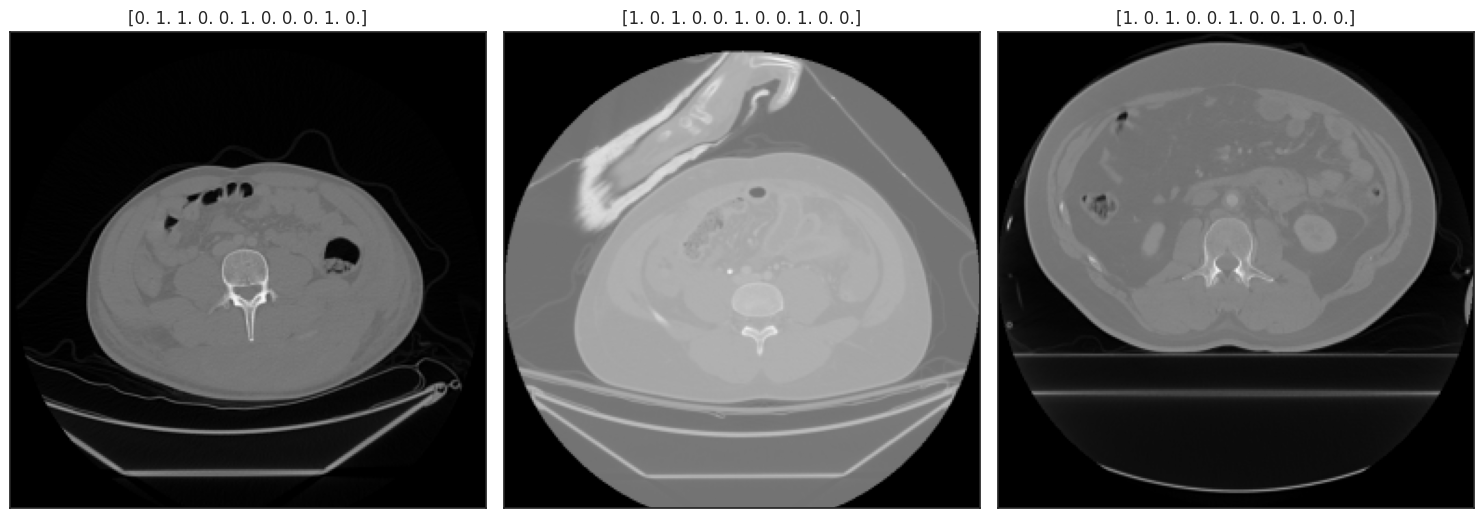
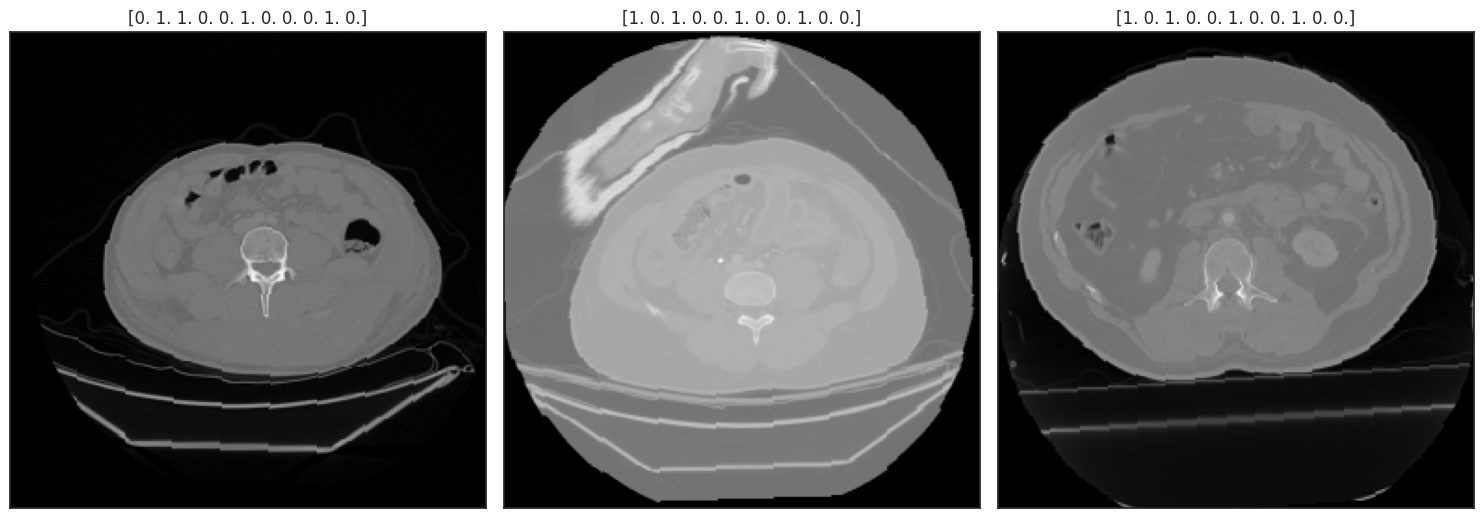
- Check if augmentation is working properly or not.
def display_batch(batch, size=2):
    if isinstance(batch, tuple):
        imgs, tars = batch
    else:
        imgs = batch
        tars = None
    tars = tf.concat(tars,axis=-1).numpy()
    plt.figure(figsize=(size*5, 10))
    for img_idx in range(size):
        plt.subplot(1, size, img_idx+1)
        if tars is not None:
            plt.title(f'{tars[img_idx].round(2)}', fontsize=12)
        img = imgs[img_idx,]
        plt.imshow(img)
        plt.xticks([]); plt.yticks([])
    plt.tight_layout()
    plt.show()
Generate Image
fold = 0
fold_df = df[df.fold==fold].sample(frac=1.0)
paths  = fold_df.image_path.tolist()
labels = fold_df[CFG.target_col].values
ds = build_dataset(paths, labels, cache=False, batch_size=32,
                    repeat=True, shuffle=True, augment=False)
ds = ds.unbatch().batch(20)
batch = next(iter(ds))
No-Augmentation
display_batch(batch, 3);
Dropout
dimgs = tf.map_fn(lambda img: dropout(img,
    DIM=CFG.img_size,
    PROBABILITY=1.0,
    CT=10,
    SZ=0.08), batch[0])
dtars = batch[1]
display_batch((dimgs, dtars), 3);

Affine Transform
timgs = tf.map_fn(lambda img: transform(img,DIM=CFG.img_size), batch[0])
ttars = batch[1]
display_batch((timgs, ttars), 3);
Loss Function
We'll use Binary Cross Entropy loss for bowel and extravasation at the same time we'll use Categorical Cross Entropy for kidney, liver and spleen. <!-- ## BCE Loss Function for this notebook is BCE: Binary Crossentropy or Focal as the task is binary classification
where $\hat{y}_i$ is the predicted value and $y_i$ is the original value for each instance $i$.
Focal
$$\textrm{FL} = -\alpha_{t}(1 - p_{t})^{\gamma}\log{p_{t}}$$$\gamma$ controls the shape of the curve. The higher the value of $\gamma$, the lower the loss for well-classified examples, so we could turn the attention of the model more towards ‘hard-to-classify examples. FL gives high weights to the rare class and small weights to the dominating or common class. These weights are referred to as $\alpha$.
Code
tf.keras.losses.BinaryCrossentropytfa.losses.SigmoidFocalCrossEntropy-->
Build Model
from keras_cv_attention_models import efficientnet

def build_model(model_name=CFG.model_name,
                loss_name=CFG.loss,
                dim=CFG.img_size,
                compile_model=True,
                include_top=False):

    # Define backbone
    base = getattr(efficientnet, model_name)(input_shape=(*dim,3),
                                    pretrained='imagenet',
                                    num_classes=0) # get base model (efficientnet), use imgnet weights

    inp = base.inputs
    x = base.output
    x = tf.keras.layers.GlobalAveragePooling2D()(x) # use GAP to get pooling result form conv outputs

    # Define 'necks' for each head
    x_bowel = tf.keras.layers.Dense(32, activation='silu')(x)
    x_extra = tf.keras.layers.Dense(32, activation='silu')(x)
    x_liver = tf.keras.layers.Dense(32, activation='silu')(x)
    x_kidney = tf.keras.layers.Dense(32, activation='silu')(x)
    x_spleen = tf.keras.layers.Dense(32, activation='silu')(x)

    # Define heads
    out_bowel = tf.keras.layers.Dense(1, name='bowel', activation='sigmoid')(x_bowel) # use sigmoid to convert predictions to [0-1]
    out_extra = tf.keras.layers.Dense(1, name='extra', activation='sigmoid')(x_extra) # use sigmoid to convert predictions to [0-1]
    out_liver = tf.keras.layers.Dense(3, name='liver', activation='softmax')(x_liver) # use softmax for the liver head
    out_kidney = tf.keras.layers.Dense(3, name='kidney', activation='softmax')(x_kidney) # use softmax for the kidney head
    out_spleen = tf.keras.layers.Dense(3, name='spleen', activation='softmax')(x_spleen) # use softmax for the spleen head

    # Combine outputs
    out = [out_bowel, out_extra, out_liver, out_kidney, out_spleen]

    # Create model
    model = tf.keras.Model(inputs=inp, outputs=out)


    if compile_model:
        # optimizer
        opt = tf.keras.optimizers.Adam(learning_rate=0.0001)
        # loss
        loss = {
            'bowel':tf.keras.losses.BinaryCrossentropy(label_smoothing=0.05),
            'extra':tf.keras.losses.BinaryCrossentropy(label_smoothing=0.05),
            'liver':tf.keras.losses.CategoricalCrossentropy(label_smoothing=0.05),
            'kidney':tf.keras.losses.CategoricalCrossentropy(label_smoothing=0.05),
            'spleen':tf.keras.losses.CategoricalCrossentropy(label_smoothing=0.05),
        }
        # metric
        metrics = {
            'bowel':['accuracy'],
            'extra':['accuracy'],
            'liver':['accuracy'],
            'kidney':['accuracy'],
            'spleen':['accuracy'],
        }
        # compile
        model.compile(optimizer=opt,
                      loss=loss,
                      metrics=metrics)
    return model
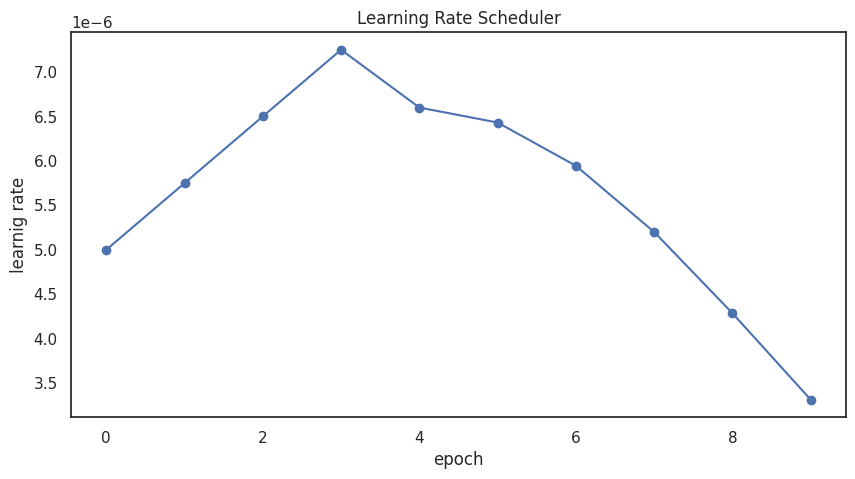
Learning-Rate Scheduler
def get_lr_callback(batch_size=8, plot=False):
        lr_start   = 0.000005
        lr_max     = 0.00000050 * REPLICAS * batch_size
        lr_min     = 0.000001
        lr_ramp_ep = 4
        lr_sus_ep  = 0
        lr_decay   = 0.8

def lrfn(epoch):
    if epoch < lr_ramp_ep:
        lr = (lr_max - lr_start) / lr_ramp_ep * epoch + lr_start

    elif epoch < lr_ramp_ep + lr_sus_ep:
        lr = lr_max

    elif CFG.scheduler=='exp':
        lr = (lr_max - lr_min) * lr_decay**(epoch - lr_ramp_ep - lr_sus_ep) + lr_min

    elif CFG.scheduler=='cosine':
        decay_total_epochs = CFG.epochs - lr_ramp_ep - lr_sus_ep + 3
        decay_epoch_index = epoch - lr_ramp_ep - lr_sus_ep
        phase = math.pi * decay_epoch_index / decay_total_epochs
        cosine_decay = 0.4 * (1 + math.cos(phase))
        lr = (lr_max - lr_min) * cosine_decay + lr_min
    return lr
if plot:
    plt.figure(figsize=(10,5))
    plt.plot(np.arange(CFG.epochs), [lrfn(epoch) for epoch in np.arange(CFG.epochs)], marker='o')
    plt.xlabel('epoch'); plt.ylabel('learnig rate')
    plt.title('Learning Rate Scheduler')
    plt.show()

lr_callback = tf.keras.callbacks.LearningRateScheduler(lrfn, verbose=False)
return lr_callback

_=get_lr_callback(CFG.batch_size, plot=True )
import cv2
import pydicom
IMG_DIR = '/kaggle/working/'

def standardize_pixel_array(dcm: pydicom.dataset.FileDataset) -> np.ndarray:
    # Correct DICOM pixel_array if PixelRepresentation == 1.
    pixel_array = dcm.pixel_array
    if dcm.PixelRepresentation == 1:
        bit_shift = dcm.BitsAllocated - dcm.BitsStored
        dtype = pixel_array.dtype
        new_array = (pixel_array << bit_shift).astype(dtype) >>  bit_shift
        pixel_array = pydicom.pixel_data_handlers.util.apply_modality_lut(new_array, dcm)
    return pixel_array

def read_xray(path, fix_monochrome = True):
    dicom = pydicom.dcmread(path)
    data = standardize_pixel_array(dicom)
    data = data - np.min(data)
    data = data / (np.max(data) + 1e-5)
    if fix_monochrome and dicom.PhotometricInterpretation == "MONOCHROME1":
        data = 1.0 - data
    return data

def resize_and_save(file_path):
    img = read_xray(file_path)
    h, w = img.shape[:2]  # orig hw
    img = cv2.resize(img, (CFG.resize_dim, CFG.resize_dim), cv2.INTER_LINEAR)
    img = (img * 255).astype(np.uint8)

    sub_path = file_path.split("/",4)[-1].split('.dcm')[0] + '.png'
    infos = sub_path.split('/')
    sub_path = file_path.split("/",4)[-1].split('.dcm')[0] + '.png'
    infos = sub_path.split('/')
    pid = infos[-3]
    sid = infos[-2]
    iid = infos[-1]; iid = iid.replace('.png','')
    new_path = os.path.join(IMG_DIR, sub_path)
    os.makedirs(new_path.rsplit('/',1)[0], exist_ok=True)
    cv2.imwrite(new_path, img)
    return
Train Model
Cross-Validation: 5 fold
  scores = []

  for fold in np.arange(CFG.folds):
      # Stop watch (start)
      start_time = time.time()

      # ignore not selected folds
      if fold not in CFG.selected_folds:
          continue

      # train and valid dataframe
      train_df = df[df["fold"]!=fold]
      valid_df = df[df["fold"]==fold]

      # get image_paths and labels
      train_paths = train_df.image_path.values; train_labels = train_df[CFG.target_col].values.astype(np.float32)
      valid_paths = valid_df.image_path.values; valid_labels = valid_df[CFG.target_col].values.astype(np.float32)
      ##test_paths  = test_df.image_path.values

      # shuffle train data
      index = np.arange(len(train_df))
      np.random.shuffle(index)
      train_paths  = train_paths[index]
      train_labels = train_labels[index]

      # min samples in debug mode
      min_samples = CFG.batch_size*REPLICAS*2

      # for debug model run on small portion
      if CFG.debug:
          train_paths = train_paths[:min_samples]; train_labels = train_labels[:min_samples]
          valid_paths = valid_paths[:min_samples]; valid_labels = valid_labels[:min_samples]

      # show message
      print('#'*40); print('#### FOLD: ',fold)
      print('#### IMAGE_SIZE: (%i, %i) | MODEL_NAME: %s | BATCH_SIZE: %i'%
            (CFG.img_size[0],CFG.img_size[1],CFG.model_name,CFG.batch_size*REPLICAS))

      # data stat
      num_train = len(train_paths)
      num_valid = len(valid_paths)
      print('#### NUM_TRAIN: {:,} | NUM_VALID: {:,}'.format(num_train, num_valid))

      # build model
      K.clear_session()
      with strategy.scope():
          model = build_model(CFG.model_name, dim=CFG.img_size, compile_model=True)

      # build dataset
      cache = 1 if 'TPU' in CFG.device else 0
      train_ds = build_dataset(train_paths, train_labels, cache=cache, batch_size=CFG.batch_size*REPLICAS,
                      repeat=True, shuffle=True, augment=CFG.augment)
      val_ds = build_dataset(valid_paths, valid_labels, cache=cache, batch_size=CFG.batch_size*REPLICAS,
                      repeat=False, shuffle=False, augment=False)
      print('#'*40)

      # callbacks
      callbacks = []
      ## save best model after each fold
      sv = tf.keras.callbacks.ModelCheckpoint(
          'fold-%i.h5'%fold, monitor='val_loss', verbose=CFG.verbose, save_best_only=True,
          save_weights_only=False, mode='min', save_freq='epoch')
      callbacks +=[sv]
      ## lr-scheduler
      callbacks += [get_lr_callback(CFG.batch_size)]

      # train
      print('Training...')
      history = model.fit(
          train_ds,
          epochs=CFG.epochs if not CFG.debug else 2,
          callbacks = callbacks,
          steps_per_epoch=len(train_paths)/CFG.batch_size//REPLICAS,
          validation_data=val_ds,
          verbose=CFG.verbose
      )

      # store best results
      best_epoch = np.argmin(history.history['val_loss'])
      best_loss = history.history['val_loss'][best_epoch]
      best_acc_bowel = history.history['val_bowel_accuracy'][best_epoch]
      best_acc_extra = history.history['val_extra_accuracy'][best_epoch]
      best_acc_liver = history.history['val_liver_accuracy'][best_epoch]
      best_acc_kidney = history.history['val_kidney_accuracy'][best_epoch]
      best_acc_spleen = history.history['val_spleen_accuracy'][best_epoch]

      # Find mean accuracy
      best_acc = np.mean([best_acc_bowel, best_acc_extra,
                          best_acc_liver, best_acc_kidney, best_acc_spleen])

      print(f'\n{"="*17} FOLD {fold} RESULTS {"="*17}')
      print(f'>>>> BEST Loss  : {best_loss:.3f}\n>>>> BEST Acc   : {best_acc:.3f}\n>>>> BEST Epoch : {best_epoch}\n')
      print('ORGAN Acc:')
      print(f'  >>>> {"Bowel".ljust(15)} : {best_acc_bowel:.3f}')
      print(f'  >>>> {"Extravasation".ljust(15)} : {best_acc_extra:.3f}')
      print(f'  >>>> {"Liver".ljust(15)} : {best_acc_liver:.3f}')
      print(f'  >>>> {"Kidney".ljust(15)} : {best_acc_kidney:.3f}')
      print(f'  >>>> {"Spleen".ljust(15)} : {best_acc_spleen:.3f}')

      print(f'{"="*50}\n\n')

      scores.append([best_loss, best_acc,
                      best_acc_bowel, best_acc_extra,
                      best_acc_liver, best_acc_kidney, best_acc_spleen])

      #Stop watch (stop)
      stop_time = time.time()
      process_time = (stop_time - start_time) // 60
      print(f"{process_time}[min]\n\n")
########################################
#### FOLD:  0
#### IMAGE_SIZE: (256, 256) | MODEL_NAME: EfficientNetV1B0 | BATCH_SIZE: 16
#### NUM_TRAIN: 9,817 | NUM_VALID: 2,212
Downloading data from https://github.com/leondgarse/keras_efficientnet_v2/releases/download/effnetv1_pretrained/efficientnetv1-b0-imagenet.h5
[Error] will not load weights, url not found or download failed: https://github.com/leondgarse/keras_efficientnet_v2/releases/download/effnetv1_pretrained/efficientnetv1-b0-imagenet.h5
########################################
Training...

================= FOLD 0 RESULTS =================
>>>> BEST Loss  : 3.435
>>>> BEST Acc   : 0.735
>>>> BEST Epoch : 8

ORGAN Acc:
  >>>> Bowel           : 0.622
  >>>> Extravasation   : 0.716
  >>>> Liver           : 0.881
  >>>> Kidney          : 0.694
  >>>> Spleen          : 0.763
==================================================


24.0[min]


########################################
#### FOLD:  1
#### IMAGE_SIZE: (256, 256) | MODEL_NAME: EfficientNetV1B0 | BATCH_SIZE: 16
#### NUM_TRAIN: 8,975 | NUM_VALID: 3,054
Downloading data from https://github.com/leondgarse/keras_efficientnet_v2/releases/download/effnetv1_pretrained/efficientnetv1-b0-imagenet.h5
[Error] will not load weights, url not found or download failed: https://github.com/leondgarse/keras_efficientnet_v2/releases/download/effnetv1_pretrained/efficientnetv1-b0-imagenet.h5
########################################
Training...

================= FOLD 1 RESULTS =================
>>>> BEST Loss  : 3.291
>>>> BEST Acc   : 0.751
>>>> BEST Epoch : 2

ORGAN Acc:
  >>>> Bowel           : 0.547
  >>>> Extravasation   : 0.716
  >>>> Liver           : 0.843
  >>>> Kidney          : 0.916
  >>>> Spleen          : 0.734
==================================================


22.0[min]


########################################
#### FOLD:  2
#### IMAGE_SIZE: (256, 256) | MODEL_NAME: EfficientNetV1B0 | BATCH_SIZE: 16
#### NUM_TRAIN: 9,012 | NUM_VALID: 3,017
Downloading data from https://github.com/leondgarse/keras_efficientnet_v2/releases/download/effnetv1_pretrained/efficientnetv1-b0-imagenet.h5
[Error] will not load weights, url not found or download failed: https://github.com/leondgarse/keras_efficientnet_v2/releases/download/effnetv1_pretrained/efficientnetv1-b0-imagenet.h5
########################################
Training...

================= FOLD 2 RESULTS =================
>>>> BEST Loss  : 3.759
>>>> BEST Acc   : 0.674
>>>> BEST Epoch : 0

ORGAN Acc:
  >>>> Bowel           : 0.461
  >>>> Extravasation   : 0.705
  >>>> Liver           : 0.870
  >>>> Kidney          : 0.854
  >>>> Spleen          : 0.477
==================================================


22.0[min]
Calculate OOF Score
  # overall oof pF1
  oof_loss, oof_acc, oof_acc_bowel, oof_acc_extra, oof_acc_liver, oof_acc_kidney, oof_acc_spleen = np.array(scores).mean(axis=0)

  print(f'\n{"="*15} OVERALL OOF RESULTS {"="*15}')
  print(f'>>>> OOF BEST Loss : {oof_loss:.3f}\n>>>> OOF BEST Acc  : {oof_acc:.3f}\n')
  print('ORGAN OOF Acc:')
  print(f'  >>>> {"Bowel".ljust(15)} : {oof_acc_bowel:.3f}')
  print(f'  >>>> {"Extravasation".ljust(15)} : {oof_acc_extra:.3f}')
  print(f'  >>>> {"Liver".ljust(15)} : {oof_acc_liver:.3f}')
  print(f'  >>>> {"Kidney".ljust(15)} : {oof_acc_kidney:.3f}')
  print(f'  >>>> {"Spleen".ljust(15)} : {oof_acc_spleen:.3f}')
  print(f'{"="*50}\n')
=============== OVERALL OOF RESULTS ===============
>>>> OOF BEST Loss : 3.495
>>>> OOF BEST Acc  : 0.720

ORGAN OOF Acc:
  >>>> Bowel           : 0.543
  >>>> Extravasation   : 0.712
  >>>> Liver           : 0.865
  >>>> Kidney          : 0.821
  >>>> Spleen          : 0.658
==================================================
Prepare Test dataset
#test_folder metadata !!!!NOTE THIS IS FOR TEST DATA !!!!
import itertools

#get patients
#patients = [patient for patient in os.listdir("/kaggle/input/rsna-2023-abdominal-trauma-detection/test_images") if os.path.isdir("/kaggle/input/rsna-2023-abdominal-trauma-detection/test_images/"+patient)]
patients = [patient for patient in os.listdir("/kaggle/input/rsna-2023-abdominal-trauma-detection/test_images")]
print("test_patient_id:", patients)

#get series
series = [os.listdir("/kaggle/input/rsna-2023-abdominal-trauma-detection/test_images/" + patient)[0] for patient in patients]
#series = list(itertools.chain.from_iterable(series)) #detouch double brackets
print("test_series_id:", series)

#get img
imgs = [os.listdir(f"/kaggle/input/rsna-2023-abdominal-trauma-detection/test_images/{patients[i]}/{series[i]}")[0] for i in range(len(patients))]
#imgs = list(itertools.chain.from_iterable(imgs)) #detouch double brackets
print("test_img_id:", imgs)

#make path
test_path=[f"/kaggle/input/rsna-2023-abdominal-trauma-detection/test_images/{patients[i]}/{series[i]}/{imgs[i]}" for i in range(len(patients))]

test_df = pd.DataFrame({
    "patient_id": patients,
    "series_id": series,
    "image": imgs,
    "path": test_path
})
test_df
test_patient_id: ['63706', '50046', '48843']
                test_series_id: ['39279', '24574', '62825']
                test_img_id: ['30.dcm', '30.dcm', '30.dcm']
| patient_id | series_id | image | path | |
|---|---|---|---|---|
| 0 | 63706 | 39279 | 30.dcm | /kaggle/input/rsna-2023-abdominal-trauma-detec... |
| 1 | 50046 | 24574 | 30.dcm | /kaggle/input/rsna-2023-abdominal-trauma-detec... |
| 2 | 48843 | 62825 | 30.dcm | /kaggle/input/rsna-2023-abdominal-trauma-detec... |
import gc

#%%time
from joblib import Parallel, delayed
file_paths = test_df.path
_ = Parallel(n_jobs=2,backend='threading')(delayed(resize_and_save)(file_path)\
                                                  for file_path in tqdm(file_paths, leave=True, position=0))
del _; gc.collect()

path_arr_img = [f"/kaggle/working/test_images/{patients[i]}/{series[i]}/{imgs[i]}".replace(".dcm", ".png") for i in range(len(patients))]
arr_df = pd.DataFrame(path_arr_img, columns=["arr_img_path"])

test_df = pd.concat([test_df, arr_df], axis=1)
test_df
100%|██████████| 3/3 [00:00<00:00, 1131.46it/s]
| patient_id | series_id | image | path | arr_img_path | |
|---|---|---|---|---|---|
| 0 | 63706 | 39279 | 30.dcm | /kaggle/input/rsna-2023-abdominal-trauma-detec... | /kaggle/working/test_images/63706/39279/30.png |
| 1 | 50046 | 24574 | 30.dcm | /kaggle/input/rsna-2023-abdominal-trauma-detec... | /kaggle/working/test_images/50046/24574/30.png |
| 2 | 48843 | 62825 | 30.dcm | /kaggle/input/rsna-2023-abdominal-trauma-detec... | /kaggle/working/test_images/48843/62825/30.png |
test_ds = build_dataset(test_df.arr_img_path,augment=False, repeat=False)
pred_results = model.predict(test_ds)
pred_results
1/1 [==============================] - 2s 2s/step
[array([[0.61479986],
                        [0.5274283 ],
                        [0.5548655 ]], dtype=float32),
                 array([[0.66972625],
                        [0.64082223],
                        [0.5338411 ]], dtype=float32),
                 array([[0.8420402 , 0.07981548, 0.07814431],
                        [0.83090025, 0.04297536, 0.12612435],
                        [0.810051  , 0.14346236, 0.04648664]], dtype=float32),
                 array([[0.8450608 , 0.10550442, 0.04943471],
                        [0.6726465 , 0.26745588, 0.05989753],
                        [0.7807357 , 0.19236377, 0.02690054]], dtype=float32),
                 array([[0.461854  , 0.19578502, 0.34236103],
                        [0.6382075 , 0.07609551, 0.28569704],
                        [0.7840603 , 0.04230442, 0.17363524]], dtype=float32)]
#patient_id
patient_df = test_df.patient_id

#binary_opposition
bowel_opposition_array = []
extravasation_opposition_array = []

for i in range(len(patients)):
    bowel_opposition_array.append(1 - pred_results[0][i])
    extravasation_opposition_array.append(1 - pred_results[1][i])

bowel_opposition_df = pd.DataFrame(bowel_opposition_array)
extravasation_opposition_df = pd.DataFrame(extravasation_opposition_array)

#binary
bowel_df = pd.DataFrame(pred_results[0])
extravasation_df = pd.DataFrame(pred_results[1])

#multi_value
kidney_df = pd.DataFrame(pred_results[2])
liver_df = pd.DataFrame(pred_results[3])
spleen_df = pd.DataFrame(pred_results[4])
columns = ["patient_id", "bowel_healthy", "bowel_injury", "extravasation_healthy", "extravasation_injury", "kidney_healthy", "kidney_low", "kidney_high", "liver_healthy", "liver_low", "liver_high", "spleen_healthy", "spleen_low", "spleen_high"]

pred_df = pd.concat([patient_df, bowel_df, bowel_opposition_df, extravasation_df, extravasation_opposition_df, kidney_df, liver_df, spleen_df],axis=1)
pred_df.columns = columns
pred_df.to_csv("/kaggle/working/submission.csv",index=False)
コメント・お問合せ
以下のツイートの『返信』にてお願いいたします